Showing posts with label Ohm's Law. Show all posts

A potentiometer is 10 m long. It has a resistance of 20 Ω. It is connected in series with a battery of 3 V and a resistance of 10 Ω. What is the potential gradient along with wire?

Given,
Length of potentiometer wire $(l) = 10\;m$
Resistance of potentiometer $(R_p) = 20\; Ω$
Potential of battery $(V_b) = 3V$
Resistance of battery $(R_b) = 10 \; Ω$
Potential Gradient $(\frac{V}{l}) = \;?$
Let $I$ be the current flowing through the circuit.
Then, from Ohm's law,
$V_b = IR$     [where R= Total resistance of the circuit = $R_b + R_p$
or, $3 = I\;*\;(10+20)$
⇒ I = 0.1 A
Since the combination is in series, the current (I) all over the circuit is same.
So, p.d in AB $(V_{AB})$ = I * $R_{b}$ = 0.1 * 20 = 2 V
Now, Potential Gradient $(\frac{V}{l}) = \frac{2}{10}$ = 0.2V/m
Hence, the potential gradient along the wire is 0.2 V/m.

Return to Main Menu

T6.1 Parallel combination of Resistors:


When the resistances are connected in parallel, the (voltage) potential difference is same across each resistor.
Consider three resistors $R_1$, $R_2$ and $R_3$ connected in parallel. All resistors have the same potential difference, but the current through each resistor is different. 
The total current, $I$ flowing in the circuit is the sum of the current in different resistors. i.e.
$I = I_1+I_2+I_3$ .......... (i)


Let $V$ be the potential difference across each resistors and $I_1$, $I_2$, $I_3$ be the current passing through $R_1$, $R_2$ and $R_3$ respectively.
From the Ohm's law:
$V = I_1\,R_1$ 
$I_1 = \frac{V}{R_1}$ .......... (ii) 
$I_2 = \frac{V}{R_2}$ .......... (iii) 
$I_3 = \frac{V}{R_3}$ .......... (iv)
From the equation (i), (ii), (iii) and (iv), we get
$I = \frac{V}{R_1} + \frac{V}{R_2} + \frac{V}{R_3}$ 
$I = V(\frac{1}{R_1} + \frac{1}{R_2} + \frac{1}{R_3})$ 
$\frac{I}{V} = \frac{1}{R_p} = \frac{1}{R_1} + \frac{1}{R_2} + \frac{1}{R_3}$
Where,    $\frac{1}{R_p}$ $ = \frac{1}{R_1} + \frac{1}{R_2} + \frac{1}{R_3}$    be the equivalence resistance of the parallel combination.
The equivalent resistance of the parallel combination is equal to the sum of reciprocal of the resistance of individuals resistors. 
The effective resistance in the parallel combination is smaller than the smallest resistance in the combination (Principle of PHYSICS).


Return to Main Menu

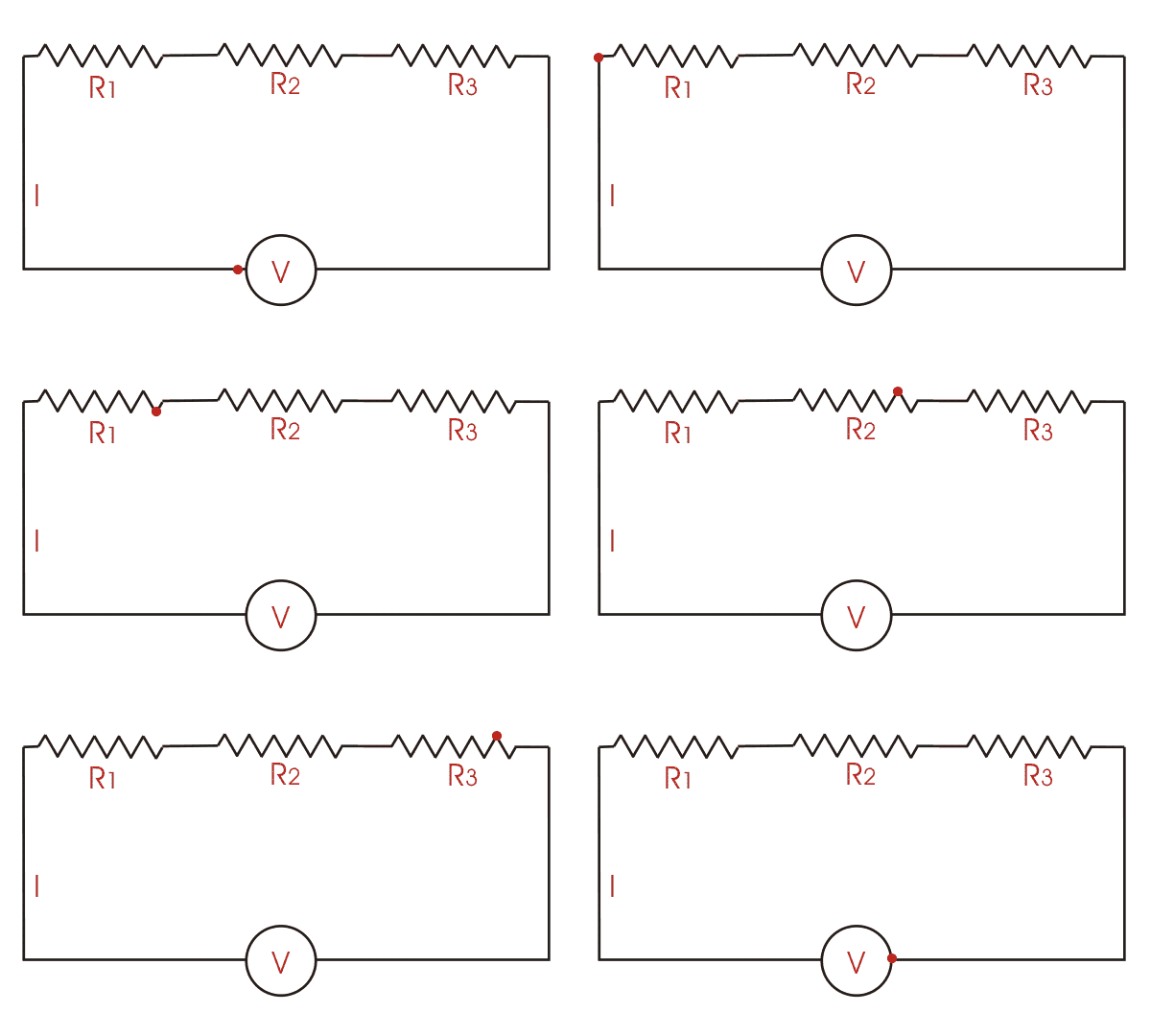
T6.1 Series combination of Resistors:


When the resistances are connected in series, the same current flow through each of the resistance.
Consider three resistors $R_1$, $R_2$ and $R_3$ connected in series. The same current flows through each resistor, but voltage (potential difference) across the resistors is different. 
The total voltage, $V$ flowing in the circuit is the sum of the Voltage in different resistors. i.e.
$V = V_1 + V_2 + V_3$ .......... (i)
Let $I$ be the current flowing through each resistor and $V_1$, $V_2$, $V_3$ be the potential difference across $R_1$, $R_2$ and $R_3$ respectively.
From the Ohm's law:
$V_1 = IR_1$ .......... (ii) 
$V_2 = IR_2$ .......... (iii) 
$V_3 = IR_3$ .......... (iv)
From the equation (i), (ii), (iii) and (iv)
$V = I\,R_1 + I\,R_2 + I\,R_3$ 
$V = I(R_1 + R_2 + R_3)$ 
$\frac{V}{I} = R_s = R_1 + R_2 + R_3$ .......... (v)
Where, $R_s = R_1 + R_2 +R_3$ be the equivalence resistance of the series combination.
The equivalent resistance of the series combination is equal to the sum of the resistance of individual resistors. 
So the equivalent resistance increase in the series combination (Principle of PHYSICS). 


Return to Main Menu

T6.1 Ohm's Law:

Ohm's Law (V = IR): is a fundamental formula in an electronics. It is used to calculate the relationship between voltage (V), current (I) and resistance (R) in an electrical circuit.
Ohm's Law states that: "The Current through a conductor between two points is directly proportional to the voltage (Potential difference) across the two points" i.e.
$V ∝ I$
 $V = I\,R$ .......... (i)
Where $R$ is a proportionality constant called resistance (R) of the conductor. This equation (i) is the mathematical form of Ohm's Law. 
 
An electric circuit is formed when a conductive path is created to allow free electrons to move continuously. This continuous movement of free electrons through the conductor of a circuit is called a Current (I).
 
The force motivating electrons to flow in a circuit is called Voltage (V). The voltage is a specific measure of potential energy that is always relative between two points.
 
Free electrons tends to move through conductors with some degree of friction (or, opposition to motion), called Resistance (R).
 
The amount of current in a circuit depends on the amount of voltage available to motivate the electrons, and the amount of resistance in the circuit to oppose electron flow (Ohm's Law).
Ohm's Law Calculator: Click here


Experimental Verification of Ohm's Law:


Return to Main Menu