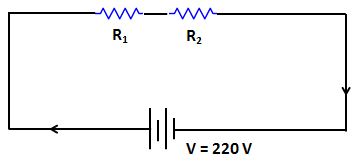
Given,
First lamp = 25 W - 220 V
Second lamp = 100 W - 220 V
Voltage (V) = 220 V
Power Consumed (P) = ?
Now, to calculate the resistance
For first lamp, $P_1 = 25\;W$
Voltage $(V_1) = 220\;V$
$R_1 = $$ \frac{V_1^{2}}{P_1} = \frac{220^2}{25}$$ = 1936\; \Omega$ [∵ $P = \frac{V^2}{R}$]
For second lamp, $P_2 = 100\;W$
Voltage $(V_2) = 220\;V$
$R_2 = $$\frac{V_2^{2}}{P_2} = \frac{220^2}{100}$$ = 484 \; \Omega$
If two lamps are connected in series and joined to 220 V mains, then the current in the circuit (I) is calculated as,
$I = $$\frac{V}{R_1 + R_2} = \frac{220}{1936 + 484}$$ = 0.091 \;A$
Finally,
Power consumed by the first lamp = $I^2*R_1 = (0.091)^2 * 1936 = 16\;W$
Power consumed by the second lamp = $I^2*R_2 = (0.091)^2 * 484 = 4\;W$
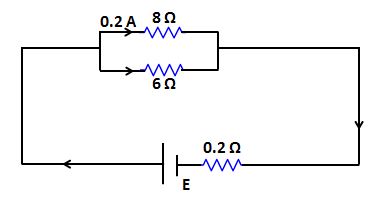
According to the given information, the electric circuit can be drawn as follows:
Given,
$r = 0.2 \;\Omega$
$R_1 = 8\;\Omega$; $I_1 = 0.2\;A$
$R_2 = 6\;\Omega$
Since $8\;\Omega$ and $6\;\Omega$ are in parallel. So the potential difference across in parallel circuit is equal.
i.e. $I_1\;R_1 = I_2\;R_2$
$I_2 =$$ \frac{I_1\; R_1}{R_2} = \frac{0.2 \; * \; 8}{6}$$ = 0.27 \; A$
Therefore total current $(I) = I_1 + I_2 = 0.2 + 0.27 = 0.47\;A $
External Resistance $(R) = R_1||R_2$$ = \frac{R_1\;R_2}{R_1 + R_2} = $$ \frac{6*8}{6+8}$$= 3.4 \; \Omega$
Now,
ஃ Emf $(E) = IR + Ir = I(R+r) = 0.47(3.4 + 0.2) = 1.7\;V$